The AI industry is suddenly talking about kill switches. That alone should tell us something important.
For decades, software systems did not require specialized kill switches. If a program misbehaved, operators could terminate a process, revoke credentials, disable a service account, or shut down infrastructure. The underlying assumption was simple: software followed deterministic control paths. Stop the program, and you stop the behavior.
Autonomous AI agents challenge that assumption.
An agent is not merely a process executing code. It is a system continuously generating, refining, and executing plans. The behavior we care about is no longer defined solely by software execution, but by the intent being operationalized through that execution.
This distinction may appear subtle, but it fundamentally changes how autonomous systems must be governed.
The Wrong Mental Model
Most discussions about AI kill switches begin with infrastructure. Organizations ask how to terminate containers, revoke tokens, disable model endpoints, or interrupt running workloads. These are valuable controls, but they are controls over compute. They answer the question:
Can this software continue running?
For autonomous systems, however, the more important question is:
Should this plan continue executing?
The difference becomes increasingly important as agents become more capable and distributed. A modern agent may coordinate across cloud services, MCP servers, APIs, databases, delegated sub-agents, and external systems. There may be no single process whose termination guarantees that the intended workflow has truly stopped. What organizations ultimately need to control is not merely execution infrastructure, but the plan itself.
The Emergence of Intent as a Security Boundary
Traditional enterprise security has focused on three questions. Identity systems determine who is acting. Access control systems determine what resources may be accessed. Network and zero-trust architectures determine where actions may occur. These controls have served enterprises well because they were designed for a world in which behavior was largely deterministic.
Autonomous agents introduce a new question:
Why is this action being taken?
An AI agent can be properly authenticated, correctly authorized, and operating within approved infrastructure while still pursuing actions that no longer align with the user’s objective. This is the problem of intent. An action may be technically valid while being purposefully wrong. An API call may be authorized while violating the user’s expectations. A plan may be executed correctly while being derived from an incorrect interpretation of the task.
Traditional security controls cannot address these situations because they govern identities, permissions, and resources. They do not govern purpose.
Why Plans Matter More Than Processes
Consider a healthcare navigation agent helping a member understand treatment options.
The workflow may involve retrieving eligibility information, querying provider networks, accessing pricing systems, evaluating coverage, generating recommendations, and coordinating follow-up actions.
Suppose an operator realizes midway through execution that the workflow should stop.
Perhaps new information has become available. Perhaps the wrong patient record was selected. Perhaps the workflow is accessing information that should not be included in the analysis. Or perhaps the operator simply wants to halt the task before proceeding further.
What should happen?
In most systems, the answer is to terminate the process executing the workflow.
But in an agentic architecture, the workflow itself is the important object. The plan may span multiple services, multiple tools, and multiple execution environments. Infrastructure termination becomes an indirect and often incomplete way of controlling behavior.
The operator does not actually want to stop a process. The operator wants to stop the plan.
See for yourself here: https://drive.google.com/file/d/1QjQlRUljGMun2TU7Go5GXjSgaFxqsacG/view?usp=drive_link
From Compute Governance to Intent Governance
This distinction sits at the core of ArmorIQ’s Intent Assurance Plane (IAP).
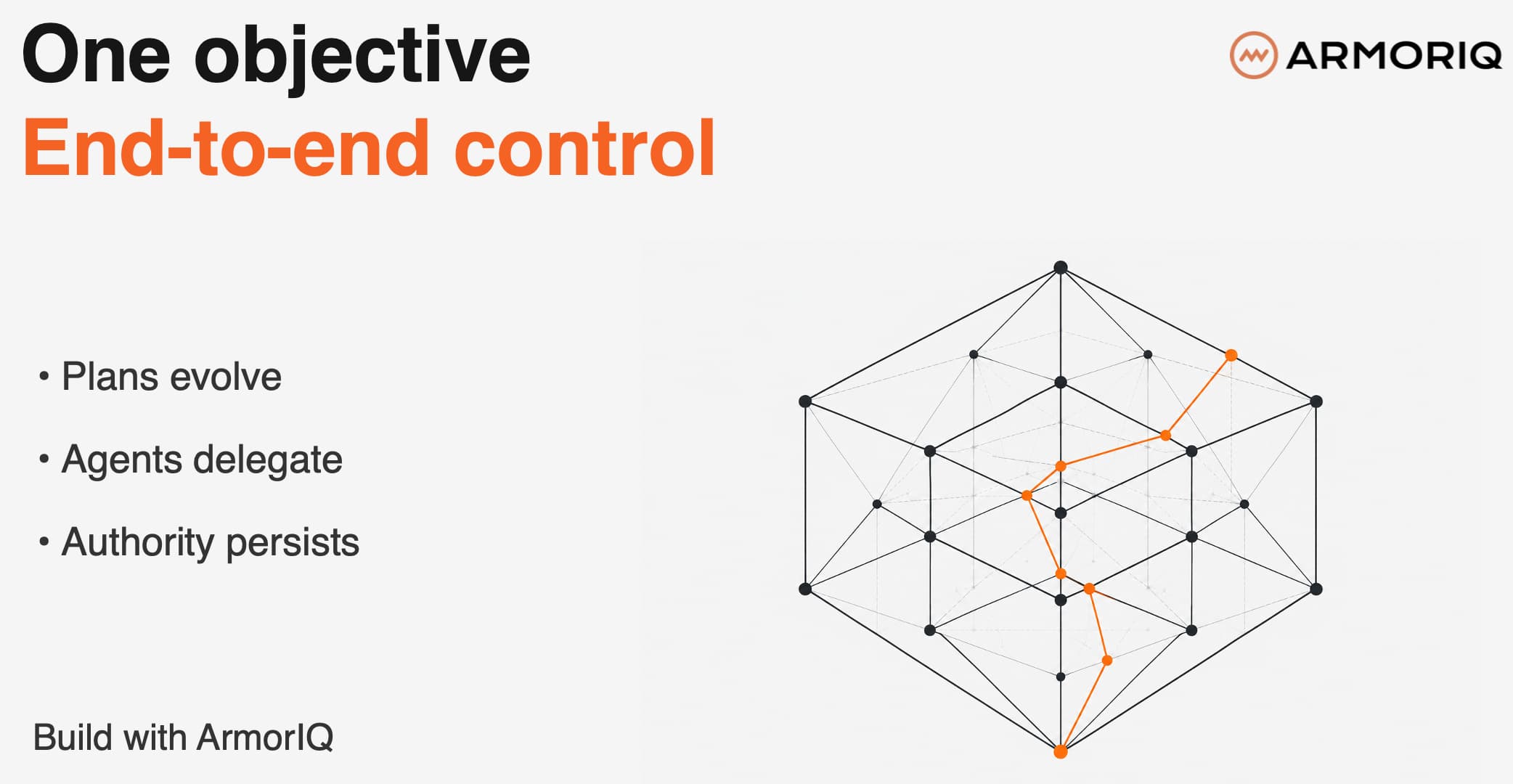
The Intent Assurance Plane treats plans as first-class security objects. Agent reasoning is transformed into a verifiable structure and cryptographically committed before execution. Every action performed by the agent must continuously demonstrate its relationship to that authorized plan before it is allowed to execute.
In effect, authorization is no longer tied solely to identity or credentials. It becomes tied to intent.
Actions are not trusted simply because an agent possesses a token. They are trusted because they can prove they belong to an approved intent lineage derived from an authorized plan.
Once intent becomes a security boundary, an entirely different type of control becomes possible.
Introducing The ArmorIQ Intent Kill Switch
ArmorIQ’s kill switch does not terminate infrastructure.It terminates intent. When an operator selects Kill Plan, the running plan is moved into a terminal state. Every subsequent tool invocation must still pass through the Intent Assurance Plane before execution.
At the next execution step, ArmorIQ verifies the plan’s status. If the plan has been killed, authorization is denied before policy evaluation occurs. The requested action is blocked and the workflow stops.
The enforcement mechanism is deliberately simple. The agent does not decide whether it should stop. The model does not decide whether it should stop. The workflow does not decide whether it should stop. The authorization to continue no longer exists.
The result is a control mechanism that operates independently of the agent’s behavior and independently of the underlying infrastructure. The plan loses its authority to act, and execution ceases at the next enforcement boundary.
Auditability and Accountability
Stopping an autonomous workflow is only part of the problem. Organizations also need evidence.
Every plan termination performed through ArmorIQ generates a verifiable audit trail. The system records who initiated the termination, when it occurred, which plan was affected, and every subsequent execution attempt that was denied because the plan was no longer authorized.
This creates a complete operational record of intervention and enforcement. Rather than simply observing that a workflow stopped, operators can demonstrate precisely why it stopped, who initiated the action, and how the system prevented additional execution.
As autonomous systems become increasingly involved in regulated workflows, this level of accountability becomes as important as the enforcement mechanism itself.
A Small Feature That Signals a Larger Shift
Recently, we demonstrated this capability using ArmorHealth’s Member Care Navigator agent.
The workflow began normally. After the first step completed, an operator terminated the plan from the ArmorIQ dashboard. When the agent attempted to execute the next step, the Intent Assurance Plane rejected the request. Execution stopped immediately. The dashboard reflected the termination, and the audit trail captured both the operator action and the blocked execution attempt.
Operationally, this appears to be a simple kill switch. Architecturally, however, it represents something much larger. It represents a shift from governing infrastructure to governing intent. The industry has spent decades building identity infrastructure for people, services, and applications. Autonomous systems require a new layer that governs purpose itself.
Today that manifests as an intent-aware kill switch. Tomorrow it will extend to delegation control, purpose-preserving refinement, authority propagation, multi-agent coordination, and continuous verification of autonomous behavior. The future of AI governance will not be defined solely by who an agent is or what resources it can access. It will be defined by whether the agent should still be allowed to pursue the intent it was given.
Most AI kill switches stop compute. ArmorIQ stops intent