Most conversations about the EU AI Act still sound like conversations about paperwork. Risk classifications. Technical documentation. Transparency obligations. Conformity assessments.
And if you only read the regulation at the surface level, it is easy to see why. The Act introduces a broad framework for governing AI systems based on risk, particularly around high-risk deployments involving infrastructure, healthcare, employment, finance, and public systems. (Wikipedia)
But underneath the legal language, something much more important is happening. The EU AI Act is quietly forcing the industry to confront a problem that most AI systems are not architected to solve:
“how do you govern systems that continuously construct behavior at runtime?”
That question matters because the systems being deployed today are fundamentally different from traditional software. They do not simply execute predefined logic. They interpret, refine, plan, delegate, and evolve behavior while already interacting with real systems.
And once that starts happening, compliance stops being a documentation problem. It becomes a systems problem.
The Act keeps using words the ecosystem still cannot operationalize
If you read the AI Act carefully, a pattern emerges. The regulation repeatedly asks for things like:
human oversight
traceability
robustness
accountability
transparency
post-market monitoring
risk management
cybersecurity
governance across the lifecycle of the system
At first glance, these sound familiar because traditional software compliance has used similar language for years. But there is a hidden assumption underneath most existing compliance systems:
that behavior is stable enough to inspect after the fact.
That assumption breaks for agents. A static model card or audit report is useful when software behavior is predefined. It becomes much less meaningful when plans are generated dynamically at runtime and evolve continuously as the system reasons. Recent work around the AI Act has started identifying this exact gap, particularly around behavioral drift, runtime autonomy, and the inability of current governance systems to reason about evolving plans. (arXiv)
The problem is no longer simply:
“what did the system do?”
It becomes:
“how did the system decide what to do?”
That is a very different category of problem.
Why existing governance approaches struggle with agents
Most enterprise AI governance systems still operate at isolated layers.
Identity systems govern who can act.
Policy engines govern what resources can be accessed.
Security systems inspect execution boundaries.
Observability systems reconstruct what happened afterward.
All of these remain useful. But none of them govern how behavior is constructed.
That distinction matters because modern agent systems do not move directly from request to execution. A request is interpreted, refined into a plan, delegated across tools or sub-agents, and gradually turned into actions. By the time execution begins, the system is often operating on a version of the task that it has constructed for itself.
This is precisely the class of failure the ecosystem keeps running into.
The system stays authenticated.
The actions remain authorized.
The runtime behaves correctly.
And yet the overall behavior drifts from the original purpose.
The EU AI Act repeatedly points toward this issue indirectly through requirements around traceability, human oversight, runtime robustness, and post-deployment governance. (TechRadar)
But most systems today still lack the architectural primitives needed to operationalize those requirements in real agent environments.
Why ArmorIQ was designed around this problem from the beginning
From the beginning, ArmorIQ was built around the assumption that AI systems would eventually need governance at the level of reasoning itself.
That is why the architecture evolved around three connected layers.
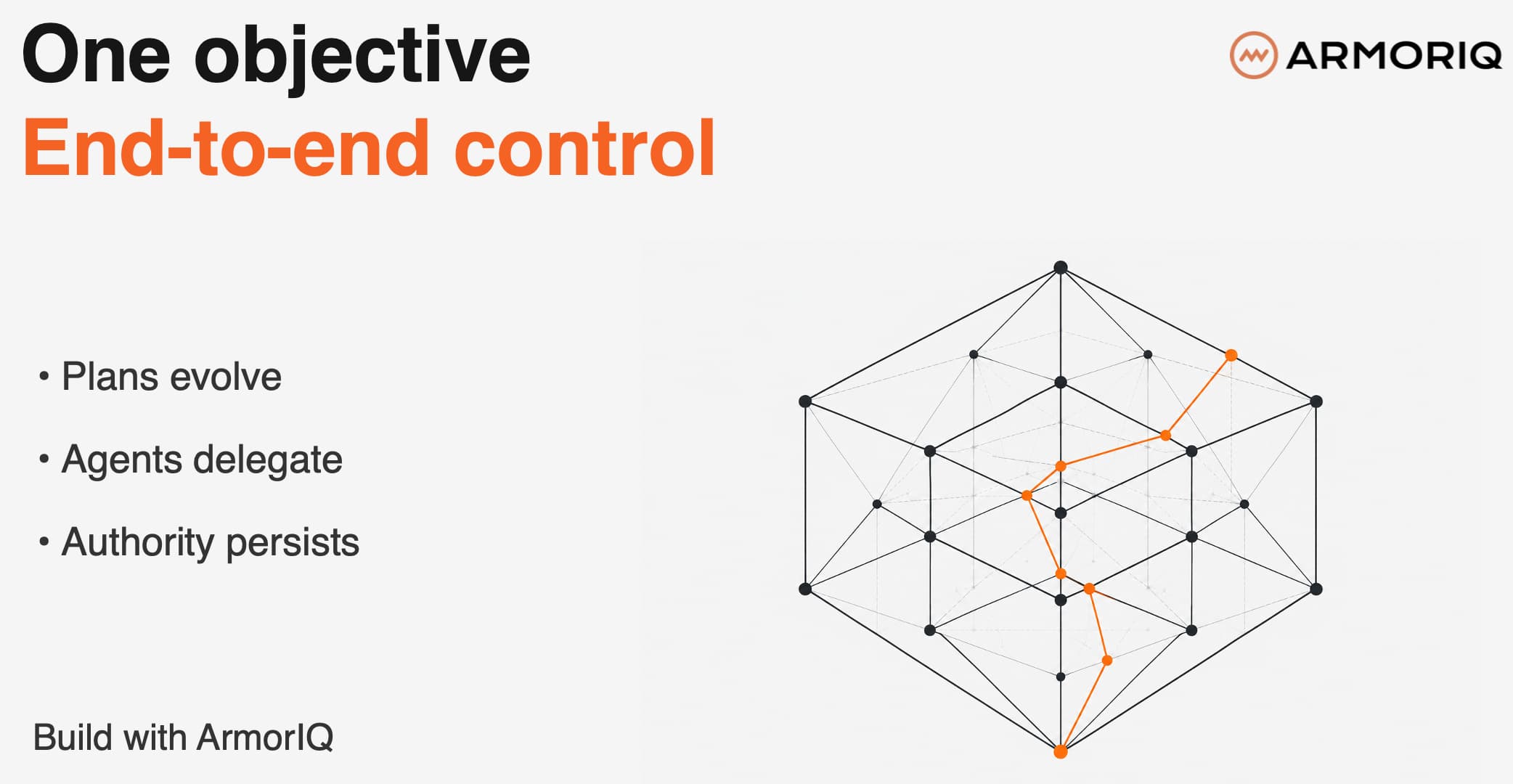
The first layer focuses on execution integrity. Actions are cryptographically bound to structured plans so that every execution can be traced back to the reasoning structure that produced it. Instead of verifying only who acted, the system verifies whether the action still belongs to the committed plan lineage.
The second layer governs refinement itself. Modern agent systems continuously transform intent into plans and plans into actions. ArmorIQ treats this as a chain of refinements that must preserve both meaning and authority over time. As uncertainty decreases, the system is prevented from silently expanding its capabilities or weakening constraints.
The third layer, which is emerging through the roadmap, focuses on behavioral assurance at the model layer itself, including classification of reasoning patterns, trust dynamics, and runtime behavioral signals.
Taken together, this creates something much closer to a continuous governance fabric than a traditional compliance tool.
And that distinction matters. Because the AI Act is not ultimately asking companies to produce more PDFs. It is asking whether these systems can actually be governed while they are operating.
The interesting thing is that compliance becomes a side effect
One of the strange things about the EU AI Act is that many organizations are approaching it backward. They start from compliance requirements and work downward toward implementation. In practice, the harder problem is operational.
Can you:
explain why an action occurred?
reconstruct how a plan evolved?
prove that delegated behavior remained bounded?
revoke evolving authority safely?
detect when the system drifted?
maintain traceability across runtime refinement?
If the answer is no, then compliance becomes fragile almost immediately. But if those primitives exist operationally, many of the AI Act requirements begin to emerge naturally as properties of the architecture itself.
Traceability becomes built-in lineage. Human oversight becomes enforceable interruption points. Post-market monitoring becomes continuous reasoning telemetry. Risk management becomes bounded authority evolution. Cybersecurity becomes constraining how plans are allowed to evolve, not just protecting runtime perimeters.
This is why we increasingly think of the AI Act less as regulation layered onto AI systems and more as an early signal of where the architecture of AI systems is inevitably heading.
The systems that survive will be the ones that are governable
One of the most important ideas hidden inside the AI Act is that trustworthiness is not a static property. It is operational. A system is trustworthy only if its behavior remains bounded and explainable while it is evolving in real time.
That is fundamentally different from how most software governance has historically worked. Traditional software mostly executes predefined behavior. Agentic systems construct behavior dynamically. And once that happens, governance has to move earlier in the lifecycle of the system itself.
Not just at execution. But during construction.
Why this matters beyond Europe
The EU AI Act matters because it is likely the first large-scale attempt to operationalize governance for systems that behave probabilistically and autonomously. Like GDPR before it, the architecture it pushes organizations toward will likely extend far beyond Europe. (Investopedia)
The interesting question is not whether companies will need compliance tooling. They will.
The deeper question is whether the underlying systems themselves are architected in a way that makes continuous governance possible at all. Because once agents start constructing behavior at runtime, compliance and security stop being separate problems.
They become the same problem viewed from different directions. And the systems that survive long-term will be the ones designed around that reality from day zero.