If you read the newer draft guidance around high-risk AI systems carefully, the document repeatedly circles around the same unresolved tension. The systems being regulated are no longer static models producing isolated outputs. They are increasingly autonomous systems operating across workflows, infrastructure, organizational processes, and human environments. (digital-strategy.ec.europa.eu)
And once systems start behaving that way, the old governance assumptions begin failing almost immediately. The guidance keeps returning to ideas like:
lifecycle risk management
human oversight
traceability
technical robustness
cybersecurity
logging
post-market monitoring
governance of evolving behavior
At first glance, these sound like familiar compliance concepts. But if you look closely, the document is actually describing a much deeper systems problem:
how do you govern systems that continuously construct behavior at runtime?
That question sits underneath almost every difficult requirement in the AI Act. And it is precisely the problem ArmorIQ was designed around from the beginning.
The AI Act assumes behavior is evolving, not static
Traditional compliance systems work reasonably well for static software because the relationship between intent and execution is relatively stable. A developer defines behavior, infrastructure executes it, and governance layers verify whether the system operated within approved boundaries.
Agentic systems break that relationship.
A request enters the system incomplete. The runtime interprets it, refines it into plans, selects tools, accumulates context, delegates subtasks, and continuously reconstructs what it believes the task requires while already interacting with infrastructure.
The system is no longer simply executing behavior. It is constructing behavior dynamically while it runs.
This distinction appears everywhere in the AI Act guidance, even when it is not stated directly. The repeated emphasis on lifecycle governance, post-deployment monitoring, and ongoing risk management reflects an implicit recognition that these systems do not remain behaviorally stable after deployment. (digital-strategy.ec.europa.eu)
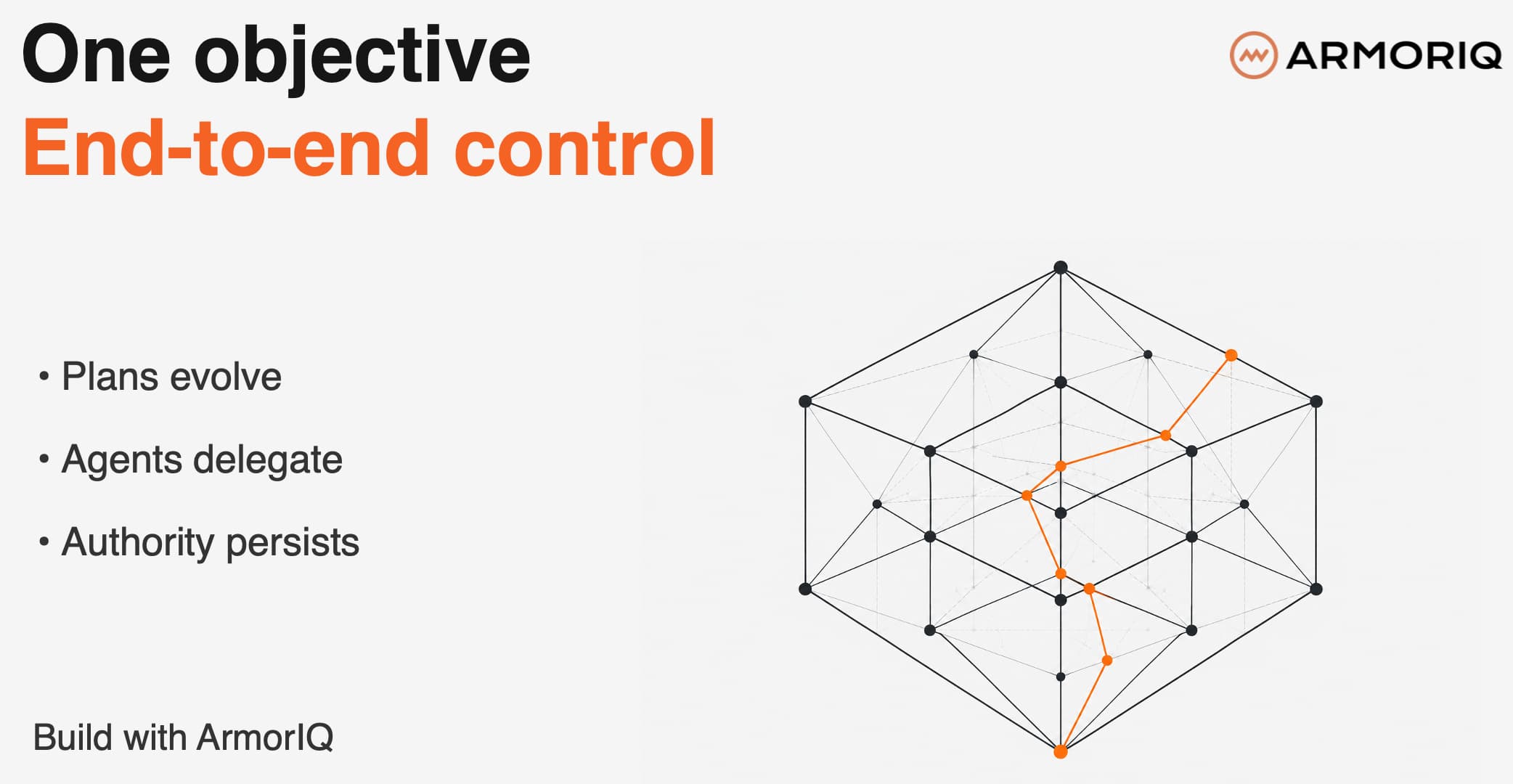
That is exactly why ArmorIQ was built around runtime intent continuity rather than static execution policies. The core assumption behind the platform has always been that governance has to persist while the system is evolving, not merely before or after execution.
Traceability becomes impossible without reasoning lineage
One of the strongest themes throughout the guidance is traceability.
The regulation repeatedly emphasizes the need to reconstruct how decisions were made, particularly in high-risk systems operating in areas like employment, healthcare, finance, infrastructure, and public services.
Most current AI observability systems interpret this as a logging problem. But logs alone are not enough once plans evolve dynamically. An execution log can tell you:
which API was called
which model responded
which tool executed
which user authenticated
It usually cannot explain how the system gradually arrived at that action in the first place. That distinction becomes critical in agent systems.
A coding agent may begin by inspecting deployment scripts, then gradually expand into operational infrastructure because the reasoning process evolved toward that conclusion. Every individual action may remain technically valid. The drift occurs in the transformation between intent and execution.
This is why ArmorIQ treats reasoning itself as a first-class object.
The Intent Assurance Plane converts evolving plans into structured reasoning graphs with cryptographic lineage between refinement stages and execution. That means traceability is not reconstructed after the fact. It is continuously preserved while the system evolves.
Human oversight stops meaning “approval buttons”
The AI Act repeatedly stresses meaningful human oversight. Most organizations interpret this operationally as workflow approvals, escalation points, or kill switches. But the deeper issue is subtler.
In agent systems, the dangerous transition often occurs long before a human-visible action appears. A workflow slowly accumulates assumptions while refining a task. The system continuously reinterprets what it believes the objective requires. By the time a high-risk action becomes visible, the reasoning process that justified it may already have drifted significantly from the original intent.
This is why traditional approval checkpoints often feel strangely ineffective in agentic systems. The important decision already happened upstream.
ArmorIQ approaches this differently by treating oversight as intervention during refinement itself. The Purpose Assurance Plane models behavior as a chain from human purpose to operational intent to executable actions and enforces monotonicity during that refinement process.
The practical effect is important. As uncertainty decreases, the system is not allowed to silently expand authority or weaken constraints. Plans that drift outside the original capability boundary are rejected before execution occurs. Human oversight becomes meaningful again because the system remains bounded while it evolves.
Cybersecurity becomes a reasoning problem
The guidance also repeatedly links high-risk AI governance to cybersecurity obligations. That connection becomes much clearer once you realize that modern agent systems often fail before runtime security controls ever trigger.
A prompt injection attack is rarely just a “bad input.” It is a manipulation of the reasoning process itself. The system slowly changes how it interprets the task, expands its operational scope, and eventually justifies actions that appear coherent from inside the runtime.
The dangerous part is that nothing may look compromised from the perspective of traditional infrastructure security. The credentials remain valid. The runtime remains authenticated. The API calls remain legitimate. The drift happened inside the reasoning process.
This is precisely why ArmorIQ focused so heavily on bounded delegation, plan continuity, and authority refinement from the beginning. The system continuously verifies whether evolving plans remain inside the authority boundaries originally established by the task. In practice, this turns reasoning drift itself into a governable security surface.
Post-market monitoring becomes continuous behavioral governance
One of the more revealing parts of the AI Act is the emphasis on post-market monitoring and continuous operational governance.
Traditional compliance systems assume that software remains relatively stable after release. AI agents violate that assumption naturally because they evolve behavior dynamically in response to context, memory, tools, and environmental interaction. This means governance cannot stop at deployment. The system itself keeps changing.
ArmorIQ was architected around exactly this operational reality. Audit lineage, trust updates, delegated authority evolution, and runtime verification are all designed to preserve continuity while the system adapts.
The important shift here is conceptual. Monitoring is no longer just about observing outputs. It becomes about continuously governing how the system evolves its own understanding of the task.
The AI Act is quietly pushing the ecosystem toward a new architecture
One of the reasons the EU AI Act feels difficult to operationalize today is that most of the ecosystem is still trying to apply traditional governance models to systems that no longer behave like traditional software. The regulation keeps describing properties that static systems never had to maintain continuously:
evolving trust
behavioral continuity
bounded delegation
lifecycle governance
runtime accountability
Those concepts sound awkward today because the infrastructure layer needed to support them is still emerging. But once you spend enough time around modern agent systems, the direction becomes difficult to ignore. The stack is slowly evolving toward:
persistent runtimes
evolving plans
delegated reasoning
operational memory
continuous refinement
And once systems begin continuously constructing behavior while already interacting with the world, governance has to move into the runtime itself. Not after execution. During construction. That is the layer ArmorIQ was designed around from the beginning.
Which is why the AI Act increasingly feels less like an external compliance burden and more like the first serious attempt to describe the architectural properties these systems were always going to need anyway.