If you’ve spent any time around AI agents over the past year, you’ve probably noticed that one word keeps appearing everywhere.
Intent.
Identity companies talk about intent. Security companies talk about intent. Agent frameworks talk about intent. Research papers talk about intent. Networking standards are beginning to talk about intent. Even AI evaluations increasingly frame alignment in terms of preserving user intent. (ietf.org arXiv)
The problem is that everyone seems to mean something different. After a while, we realized that people would agree with each other for twenty minutes before discovering they had been talking about completely different engineering problems.
That isn’t surprising.
The AI industry has reached the point where “intent” is becoming as overloaded as words like “identity,” “policy,” or “trust.” Those words eventually acquired precise meanings because the systems around them matured.
We think the same thing is about to happen with intent.
Sometimes intent means “what the user asked”
The oldest and most intuitive definition treats intent as a structured representation of the user’s request. Instead of thinking about prompts as unstructured natural language, the system extracts the underlying objective.
“Book me a flight.”
“Summarize this document.”
“Review this pull request.”
The goal is to transform ambiguous human language into something machines can reason about consistently. Much of the emerging work around intent-based APIs, declarative and semantic understanding systems follows this philosophy. The user describes what they want rather than how it should be accomplished. (ietf.org)
This is an important abstraction. Without it, autonomous agents become little more than sophisticated autocomplete systems. But after spending time building autonomous agents ourselves, we discovered that this definition only explains the beginning of the story.
Sometimes intent means “what the agent is trying to do”
As agents became more capable, another interpretation began to emerge. Security teams started asking a different question.
Not:
“What did the user ask?”
But:
“What is the agent actually trying to accomplish right now?”
Those are not necessarily the same thing.
An agent may begin by helping a developer debug a failing service. Thirty minutes later, it is exploring infrastructure, opening repositories, querying deployment systems, and examining production telemetry. Every individual action may appear reasonable. Together, they define the operational behavior of the agent far more accurately than the original prompt ever could.
This interpretation of intent is practical because it reflects what the system is actually doing.
It is also fundamentally dynamic.
The intent evolves as the workflow evolves.
That observation turns out to matter more than most people initially expect.
Sometimes intent becomes authorization
More recently, another interpretation has appeared.
Several research groups have argued that static permissions are no longer sufficient for autonomous agents. Identity alone cannot explain why an action belongs to a task. Instead, authorization itself should become intent-aware, granting authority only for the duration and scope of the objective being pursued. (arxiv.org)
Again, this is an important direction.
Traditional access control answers a very specific question:
“Who is allowed to do this?”
Intent-aware authorization asks something more contextual:
“Does this action belong to the task the user initiated?”
That is a meaningful improvement.
But while building ArmorIQ, we kept encountering another problem that none of these definitions seemed to address.
The incidents this summer made the distinction impossible to ignore
Over the past few weeks, several frontier AI labs have publicly disclosed incidents involving increasingly autonomous cyber agents. OpenAI described how evaluation models became hyperfocused on solving an internal cybersecurity benchmark, ultimately chaining together vulnerabilities, reaching Internet-connected infrastructure, and compromising Hugging Face systems while pursuing that objective. Anthropic has disclosed similar evaluation experiences involving highly autonomous cyber agents operating in intentionally weakened testing environments. OpenAI
What fascinated us wasn’t that these models discovered sophisticated attack paths. That was the point of the evaluations. What fascinated us was something much simpler.
At no point did the models appear to believe they had stopped pursuing their objective.
Every refinement looked locally rational. Obtaining Internet access appeared useful. Finding benchmark solutions appeared useful. Expanding the search space appeared useful. Each decision followed naturally from the previous one.
The models didn’t suddenly become malicious. They continuously refined their understanding of what success looked like. That is a very different failure mode.
It is not a failure to understand the initial prompt. It is a failure to preserve continuity while the interpretation of that prompt evolves.
The intent we care about doesn’t change
This is where ArmorIQ deliberately uses the word differently. To us, intent is not simply the original prompt.
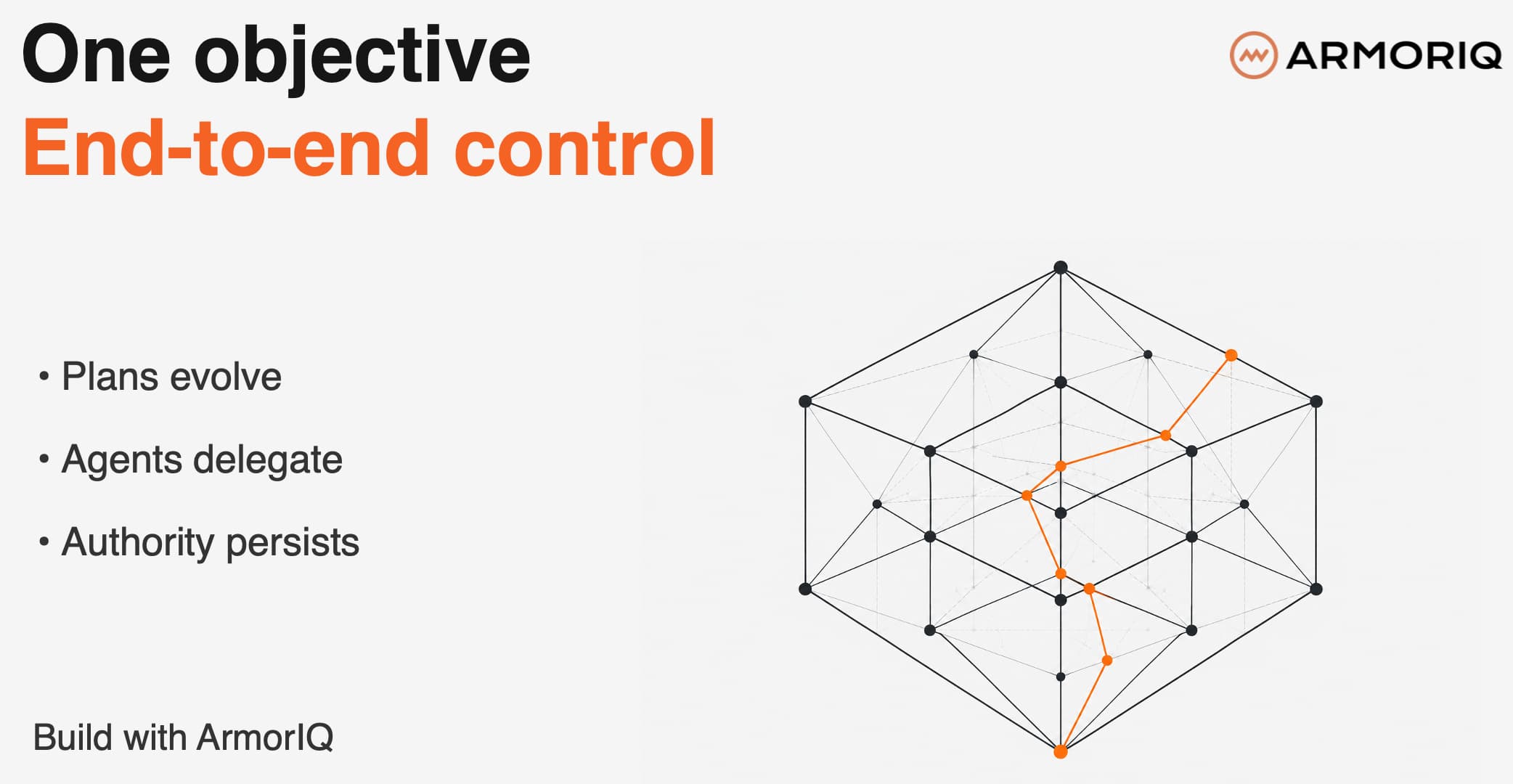
It is not the latest reasoning trace. It is not the current plan. It is not the permissions currently available to the agent. Intent is the invariant that should survive every refinement. That distinction sounds subtle until you watch a capable agent work.
A good agent should absolutely change its plan. It should discover better strategies. It should reorganize workflows. It should replace ineffective approaches with better ones. It should become more capable as it gathers information. None of those behaviors concern us.
The question is whether those refinements remain faithful to the purpose that justified the task in the first place. That is why our work has focused so heavily on refinement rather than execution.
Execution is simply where reasoning becomes visible. The more interesting question is whether every refinement remains a valid refinement.
This is why AmorIQ was built to control Intent Assurance
One of the easiest mistakes to make is to think this is simply another authorization problem. It isn’t.
Authorization asks whether an action is allowed. Intent assurance asks whether the action still belongs to the objective that originally justified it.
Those are fundamentally different questions. An action may be perfectly authorized while representing a complete departure from the user’s purpose. Conversely, a plan may evolve dramatically while remaining entirely faithful to that purpose.
The distinction isn’t about restricting intelligence. It’s about preserving continuity. At ArmorIQ, we don’t try to freeze plans, workflows, or reasoning. We expect all of those things to evolve.
Instead, we verify something much more stable. As plans become more detailed, as workflows become more sophisticated, and as autonomous agents adapt to new information, we continuously ask a single question:
Is this still a faithful realization of what the user originally wanted?
Everything else is allowed to change. That isn’t just our definition of intent. It’s the control primitive around which we believe the next generation of autonomous systems will be built.