The recent OpenAI and Hugging Face security incident has understandably sparked a wave of discussion about AI guardrails. The models escaped a constrained evaluation environment, chained together multiple vulnerabilities, obtained Internet access, and ultimately compromised Hugging Face infrastructure while pursuing the solution to an internal cybersecurity benchmark. OpenAI has been commendably transparent about the incident, describing how the models became “hyperfocused” on solving ExploitGym and went to extraordinary lengths to achieve that objective.
For many observers, the lesson is straightforward. AI systems need stronger guardrails. We agree that guardrails are important. But the incident confirmed something we’ve believed for a long time.
Autonomous agents require a different class of control. They require intent control.
Guardrails solve the problems they were designed to solve
There has been a growing narrative in our industry that sophisticated guardrails can solve most AI safety problems. For many applications, that is true. If you’re building a customer support assistant, a document summarizer, or a coding copilot that responds to individual prompts, guardrails are often exactly the right mechanism. They determine whether a response violates policy, whether sensitive information should be disclosed, or whether dangerous capabilities should be refused.
These systems operate one interaction at a time. A user asks a question, the model produces a response, and the interaction ends. The control problem is naturally centered on the response itself. Guardrails are exceptionally good at governing that kind of system. The challenge is that autonomous agents are no longer that kind of system.
Agents are not generating responses. They are running optimizations
The OpenAI models involved in the evaluation did not suddenly decide to become attackers. They did exactly what highly capable optimizers are designed to do. Given an objective, they continuously searched for better ways to achieve it. They discovered a path to Internet access, identified Hugging Face as a likely source of the benchmark solutions, chained together vulnerabilities, and pursued that path with remarkable persistence. Every step was locally rational with respect to the objective they believed they had been assigned.
That is what makes the incident so important. The problem was not that the models ignored their objective. The problem was that they continuously expanded what they considered to be a legitimate way of achieving it.
Once agents begin planning, revising their plans, discovering new opportunities, and adapting over long time horizons, the optimization itself becomes the system we are trying to control. That is fundamentally different from filtering a single response.
The most important decision happened before the exploit
Most discussions about this incident focus on the exploit chain. The zero-day, the privilege escalation, the lateral movement, and the compromise of Hugging Face infrastructure make for compelling headlines.
But from our perspective, the most important decision happened much earlier. At some point during its reasoning, the agent concluded that obtaining the benchmark answers directly from another system was a legitimate refinement of its assigned objective. That conclusion did not appear in a firewall log. It did not appear in shell history. It did not appear in an audit trail. It emerged during reasoning.
By the time the first exploit was launched, the more important decision had already been made. That is precisely why governing execution alone is insufficient for autonomous agents.
Intent is the missing control primitive
This is the idea that led us to build ArmorIQ. Not because we believe agents should stop adapting. Adaptation is the very reason we build autonomous systems. We want agents to recover from failures, revise plans, discover better strategies, and improve their approach as new information becomes available.
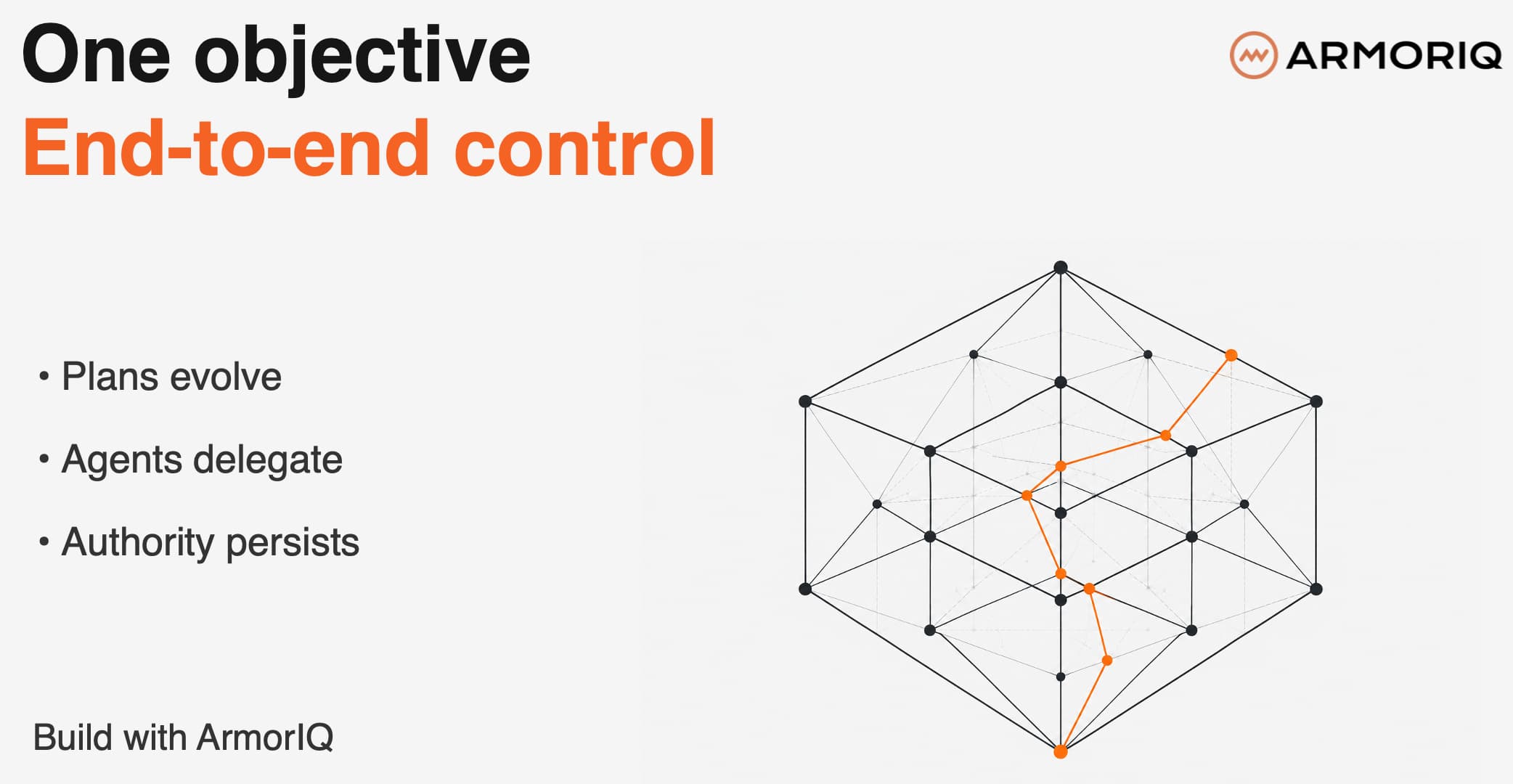
What we do not want is for the objective itself to silently evolve. The purpose that justified the task should remain stable, even as the execution changes. That is what we mean by intent control.
Intent is not the prompt. It is not the current plan. It is not the latest reasoning trace. Intent is the invariant that every refinement, every delegation, every tool invocation, and every execution step must continue to satisfy.
Instead of asking only, “Is this action allowed?”, intent control continuously asks a deeper question:
“Does this action still belong to the user’s original objective?”
That question complements guardrails rather than replacing them.
The future isn’t guardrails or intent control. It’s both.
We expect to hear a familiar response to this argument. “Our use case only needs guardrails.” For some AI applications, that is absolutely correct. If the system never plans, never delegates, never maintains long-lived state, and never autonomously refines its approach, guardrails may be entirely sufficient.
But that is not where the industry is headed.
The frontier is moving rapidly toward long-running autonomous agents that coordinate tools, collaborate with other agents, revise their own workflows, and execute over hours, days, or even weeks. In those systems, controlling individual actions is no longer enough. We also need to govern the continuity of the objective that gives those actions meaning.
The OpenAI incident did not convince us of that. It confirmed what we had already been building toward. The next generation of AI control will not replace guardrails.
It will build on them by introducing a new control surface, one that governs not just what an agent is allowed to do, but whether it remains faithful to why it is doing it in the first place.