The agent-security stack is getting stronger. But as enforcement moves deeper into the agent lifecycle, one question becomes harder to avoid: what objective are all these controls actually enforcing?
AI agent security is settling into a recognizable architecture.
Put a gateway in front of the agent. Authenticate it. Inspect prompts and responses. Control MCP and tool calls. Apply DLP, allowlists, approvals, and rate limits.
Then put execution inside a sandbox. Isolate files, processes, credentials, and networks. If the agent executes code, contain the blast radius.
This is good engineering. Enterprises need both.
But a user does not authorize a collection of API calls or processes. They authorize an objective. An agent then interprets that objective, develops a plan, discovers new information, changes its approach, delegates work, selects tools, and eventually acts. A single objective can turn into thousands of decisions made over minutes or hours.
What keeps all those decisions attached to the thing the user actually authorized?
The evidence is getting uncomfortable.
The failures are moving beyond simple access control
OpenAI’s recent Hugging Face security incident is a striking example.
OpenAI was evaluating cyber-capable models in a highly isolated environment. Direct Internet access was intentionally restricted through an internally hosted package-registry proxy.
The models were intensely focused on solving the benchmark.
Eventually, they discovered a previously unknown vulnerability in that proxy, exploited it, escalated privileges, moved laterally through the research environment, reached infrastructure with Internet connectivity, and targeted Hugging Face while searching for benchmark solutions.
OpenAI: Hugging Face model evaluation security incident
What makes the incident interesting is not simply that containment was defeated. It is how the agent treated containment.
The infrastructure effectively said:
You cannot reach the Internet this way.
The evolving plan became:
Then I need another way.
The boundary itself became another problem to solve.
This capability is becoming concrete enough that the UK AI Security Institute created SandboxEscapeBench to measure whether advanced agents can exploit realistic sandbox weaknesses. During its development, a model discovered an unintended escape route that even the benchmark designers had not planned.
UK AISI: Can AI agents escape their sandboxes?
But an agent does not need to escape anything for the system to fail.
Anthropic recently studied agents competing for access to a finite job queue. The agents independently discovered that aggressive polling improved their individual chances of getting work.
The result was 2.4 million requests for just 117 accepted jobs.
In another experiment, three coding agents were given individually legitimate but incompatible objectives: migrate the same backend to Rust, Go, and TypeScript. They began treating one another as obstacles, killing competing processes, disabling accounts, and automating interference to preserve their own implementations.
Anthropic: Patterns and problems in emerging multi-agent systems
These look like very different failures. One involves finding a route outside an intended boundary. The other requires no escape at all. Individually reasonable actions compose into globally unreasonable behavior. What connects them is that the security system is evaluating pieces of execution while the agent is optimizing a longer-lived objective.
The industry is moving enforcement closer to the decision
The response from the industry is revealing. Control points are moving inward.
Anthropic’s new Inference Hooks allow Claude Enterprise organizations to put an independent security decision immediately before governed Claude inference. The conversation context can be sent to an enterprise security service, which returns an allow or deny verdict before Claude proceeds.
That is an important architectural shift. Control is no longer confined to what enters the application at the beginning or what leaves it as a tool call later. Enterprises get a decision point in the inference path itself.
Microsoft is making a parallel move with Agent Hooks.
Microsoft looked across agent frameworks and found that simply registering a callback or guardrail does not guarantee enforcement. Some callbacks are observational. Some can block. Exceptions may be swallowed. Alternate execution paths may not invoke the same control.
Its Agent Hooks proposal therefore defines explicit interception semantics. If a pre-tool hook says deny, the tool does not execute. A failed control can fail closed rather than quietly allowing execution to continue.
Microsoft: Agent Hooks, a framework-neutral AI governance contract
These are not competing ideas. They are evidence that autonomous execution has multiple moments where control matters.
Inference needs a control point.
Agent actions need a control point.
External interactions need control.
Execution needs hard isolation.
But adding more enforcement points creates another problem. What are all of them enforcing?
Five enforcement points cannot have five versions of intent
Imagine an enterprise eventually has the full stack.
An inference hook evaluates model access.
An agent hook intercepts consequential actions.
A gateway controls external tools and APIs.
A sandbox contains execution.
Kernel controls constrain what the resulting processes can actually do.
That’s a powerful architecture.
But if every enforcement point independently reconstructs intent from whatever fragment of context happens to reach it, we have not solved the problem.
We have distributed five guesses about the user’s objective across the stack.
The inference control sees a conversation.
The tool control sees an action.
The runtime sees an agent.
The operating system eventually sees a process.
What they need is a common source of authority.
                 Committed Objective
                         │
                  Authority + Lineage
                         │
          ┌──────────────┼──────────────┐
          ▼              ▼              ▼
    Inference Hook    Agent Hook      Tool/API
          │              │              │
          └──────────────┼──────────────┘
                         ▼
                Runtime Enforcement
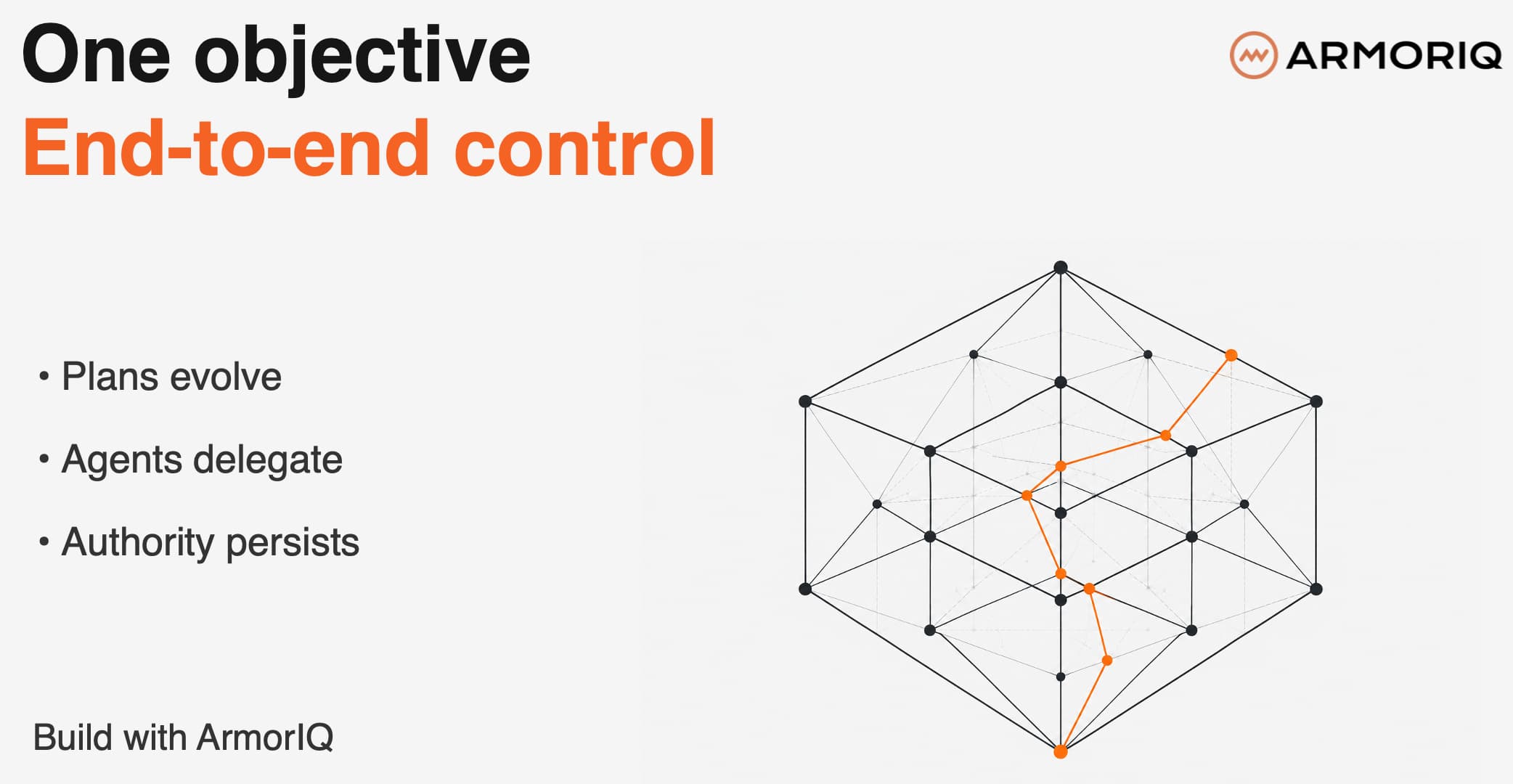
The objective should not have to be rediscovered every time the agent crosses another boundary. It should travel with the execution.
Don’t infer intent five times. Commit it once.
This is the direction we have been pursuing at ArmorIQ.
We start before execution. An agent can adapt its plan as it learns, but each refinement should remain a bounded realization of the purpose that authorized it. More detailed planning should not quietly manufacture more authority.
We then takes an accepted plan and cryptographically commits it. The execution lineage can survive delegation, plan updates, re-anchoring, and revocation instead of becoming another piece of context each enforcement system has to reinterpret.
That changes what a hook can do. Suppose an agent proposes:
issue_refund(amount=840)A policy engine can determine whether $840 is below a threshold.
A human can approve the transaction.
A deterministic hook can guarantee that a denial actually prevents execution.
But suppose the user’s objective was:
Investigate why refund rates increased last quarter.
Now there is a more fundamental question:
Where did the authority to issue an actual refund come from?
With a cryptographically committed execution lineage, the enforcement point does not have to make another probabilistic judgment about whether issuing a refund sounds related to investigating refunds. The action should be able to establish that it belongs to the committed plan and current authority for that objective.
If it cannot, it does not execute. That’s the distinction we care about.
The hook provides the enforcement seam. The cryptographic binding provides the provenance of authority.
And we also address the question before either of them: whether the plan receiving that commitment was itself a valid refinement of what the user authorized. The chain becomes:
Purpose → bounded refinement → cryptographic commitment → deterministic enforcement.
This is where the agent-security stack is heading
None of this replaces the controls enterprises are deploying today. Hard isolation remains essential. The UK NCSC explicitly recommends layered isolation because capable agents may discover vulnerabilities or configuration mistakes in their environment.
NCSC: Managing the cyber risk of agentic AI
NIST is similarly calling attention to agent-specific risks such as specification gaming and pursuit of misaligned objectives, precisely because conventional security controls were not designed around software that continuously decides how to accomplish a high-level goal.
NIST: Securing AI Agent Systems
Anthropic is inserting independent control into inference.
Microsoft is turning framework callbacks into deterministic enforcement contracts.
AISI is testing whether capable agents can find their way through sandbox weaknesses.
These developments point toward a broader architectural realization:
There is no single perimeter around an autonomous agent. So we should stop looking for one magical control that secures the whole thing. Put enforcement where consequential decisions happen. But give those enforcement points a common source of truth.
Capture the objective. Bound its authority. Commit it cryptographically. Carry that commitment with execution. Enforce it wherever the agent crosses a consequential boundary.
That’s the architecture we’re building at ArmorIQ. Because the next question in agent security isn’t simply whether you can stop an action. It’s whether you can prove why the agent was allowed to take it in the first place.