There is a point in almost every conversation we have with teams already running agents in production where the discussion changes.
The need for better controls is rarely the controversial part. Once agents can access business systems, invoke tools, move data, modify infrastructure, or initiate transactions, most teams understand that conventional logging and broad identity permissions are not enough. The harder question appears when we talk about putting a new control directly in the execution path.
What happens if the control is wrong?
For a security team, blocking an unsafe action is exactly what the system is supposed to do. For the team operating a production workflow, a false positive can itself become an incident. A policy that incorrectly blocks an invoice, interrupts an incident-response agent, or stops a customer workflow has crossed from security configuration into operational risk.
We heard that concern repeatedly from our design customers. They were not asking us for weaker enforcement. They wanted a way to understand how enforcement would behave before giving it the authority to interrupt production. That is what led us to build Monitor Mode into the ArmorIQ Intent Gateway.
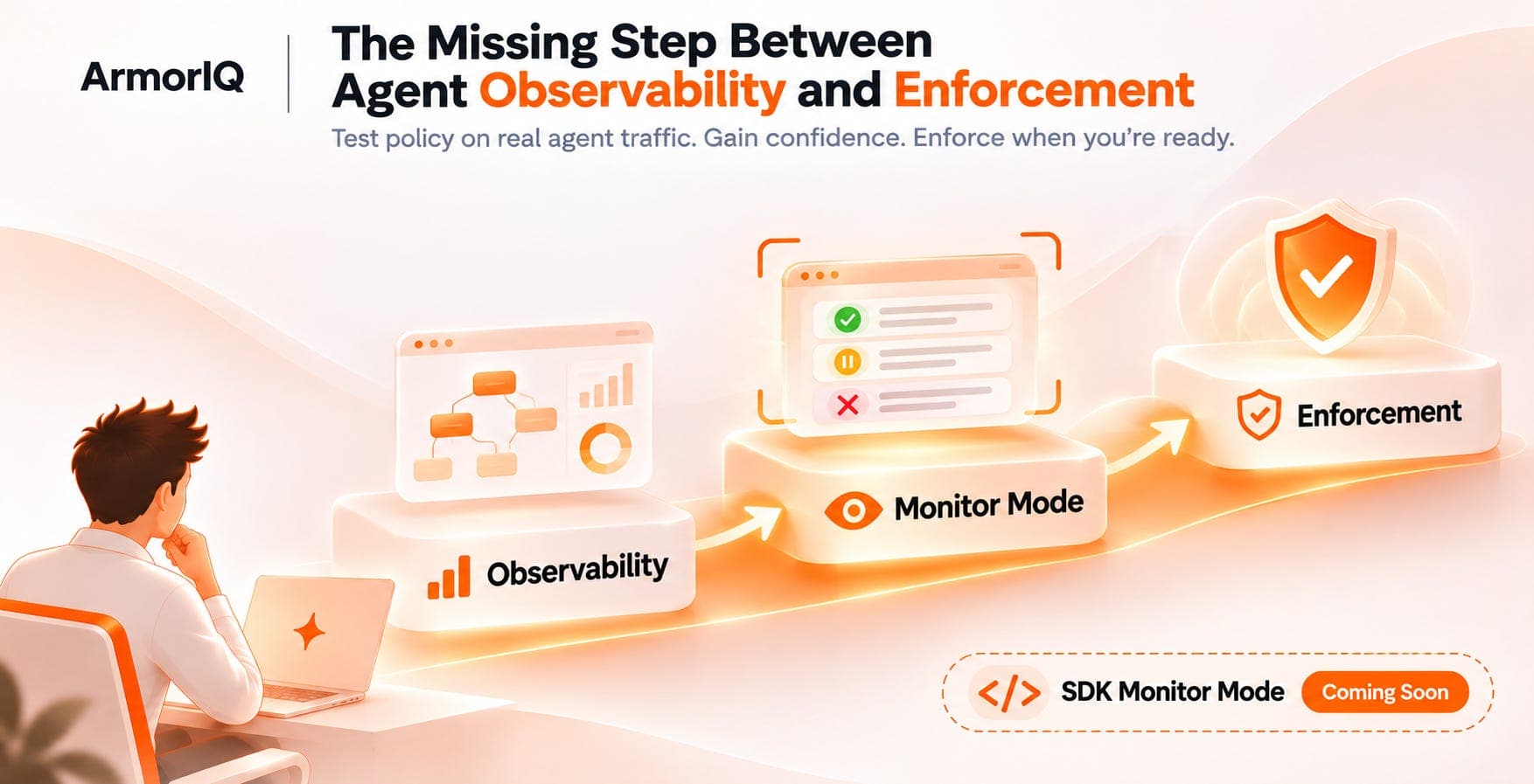
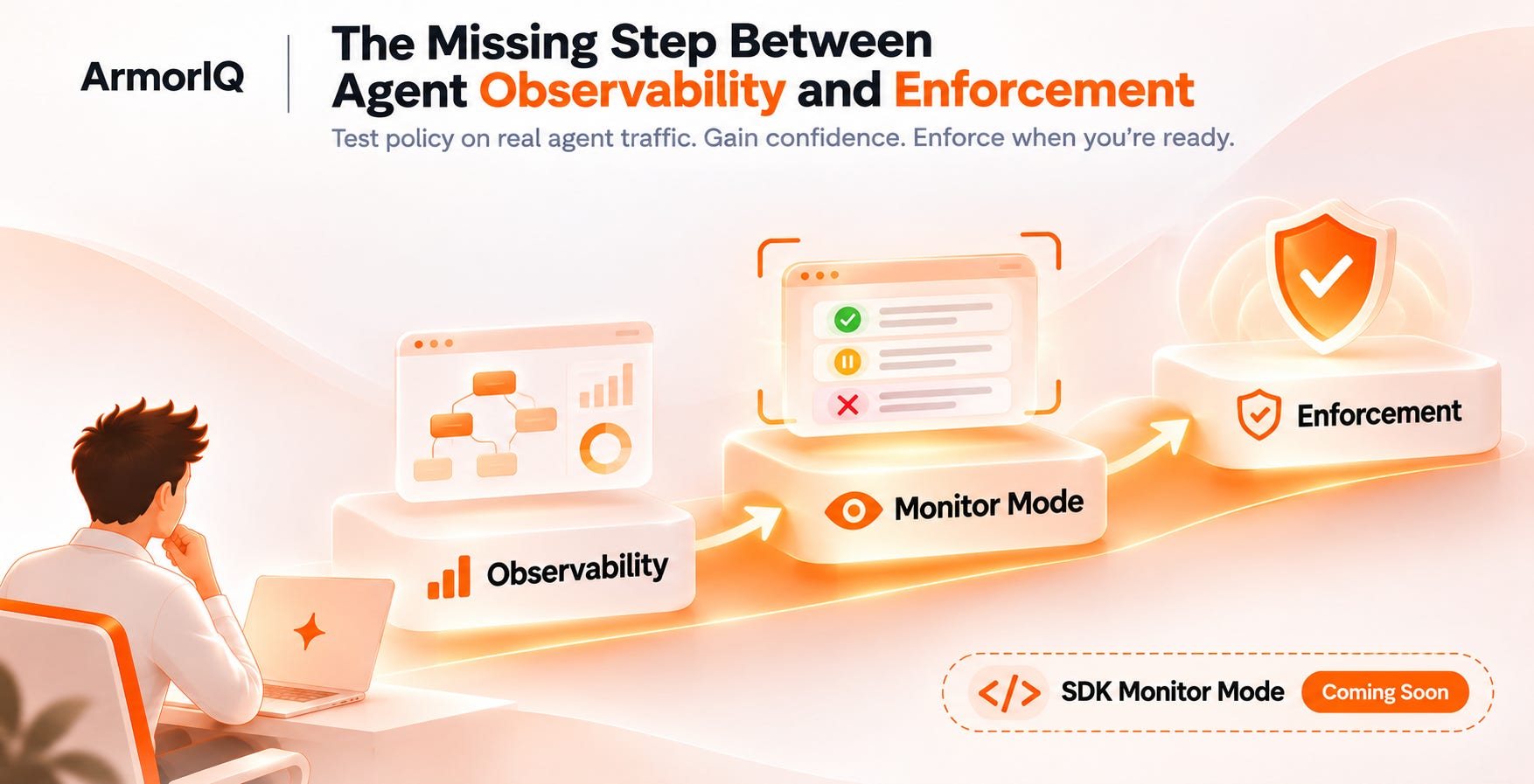
The idea sounds simple: evaluate policy against real production actions, but do not make the decision binding yet. The implications are more interesting, because it creates a missing stage between simply watching an agent and actively controlling it.
Let the policy see production before it controls production
Imagine an accounts-payable agent that has been operating successfully for months. The security team now wants to introduce a rule that would prevent certain high-value payments or require human approval under specific conditions.
The traditional deployment model asks the team to review the rule, test a few scenarios, and eventually turn it on. With a deterministic application whose workflows are known in advance, that may be reasonable. With an agent constructing plans dynamically, it is much harder to know what the policy will encounter once it meets real traffic.
Monitor Mode changes that sequence. The agent’s requests pass through the same Intent Gateway that would eventually enforce the policy. The policy is evaluated against the real action, with the real agent identity and execution context, on the actual production path. ArmorIQ determines whether the action would be allowed, held for approval, or denied.
But the agent is allowed to continue. If a $60,000 payment would have violated policy, the organization sees that the action would have been blocked. It can inspect the decision and understand the surrounding execution without discovering the policy’s effect for the first time when a real payment suddenly stops. That gives policy something it usually lacks before production deployment: exposure to reality.
Monitor Mode evaluates live agent actions against the same policy path used for enforcement, while leaving the production outcome unchanged.
When the organization eventually enables enforcement, the transition should feel almost uneventful. The integration is already in place. The policy has already seen the workload. The team already understands the actions it would affect. The decision that previously appeared as “would block” simply becomes a real block.
That continuity is the point. Monitor Mode is not another testing environment. It is a way for the control plane to earn operational confidence on the path where it will eventually exercise authority.
Why this is not just observability
It is tempting to look at Monitor Mode and call it another observability feature. We think that collapses two different moments in an agent’s lifecycle.
Observability begins with something that happened. An action executed, a tool returned a result, a model generated another step, and the system now needs to reconstruct the execution.
Monitor Mode sits before the effect. The action has been proposed, policy has been evaluated, and the gateway already knows what it would do if enforcement were active. The system deliberately chooses not to intervene. One tells us what happened. The other tells us what would have changed.
That distinction matters because a production team needs both pieces of information before it can confidently enforce policy. Seeing that an agent called a tool is useful. Knowing that a proposed control would have rejected that call is different. Understanding why the agent made the call, and whether the rejection was actually correct, requires something deeper still. That is where ArmorIQ’s approach to observability matters.
Traditional observability is exceptionally good at reconstructing deterministic software. A distributed trace can show that service A called service B, which queried database C. Logs tell us whether the operation failed. Metrics tell us whether latency increased. Agents introduce another failure mode entirely: everything can work correctly and the execution can still be wrong.
An agent may successfully call an API that has nothing to do with the user’s request. A tool may return 200 OK while the plan has quietly drifted away from its purpose. From the perspective of the infrastructure, the execution can look healthy.
The missing question is not what happened technically. It is why that action belonged to the task at all. ArmorIQ begins observability with intent capture. The trace is therefore not merely a sequence of model and tool spans. It preserves context around the purpose of the execution, the plan the agent formed, the policy decisions made along the way, the tools that were invoked, and the resulting outcome.
ArmorIQ traces an agent execution in the context of its captured intent and plan, connecting policy decisions, model interactions, tool calls, latency, cost, and outcome.
That context becomes especially valuable when Monitor Mode surfaces something unexpected. Suppose an agent produces fifty thousand actions during a week of production traffic. Almost all would have been allowed under the proposed policy. Sixty would have required human approval, and eleven would have been blocked. The interesting part is not the number eleven. The interesting part is understanding those eleven actions.
Perhaps some were exactly the behavior the security team wanted to prevent. Perhaps others reveal that the proposed policy misunderstood a legitimate workflow. One may expose a tool being used in a way nobody anticipated. Another may show that the agent’s plan drifted away from the task that originally justified its authority. Yet another may reveal something more basic, such as traffic arriving without sufficient identity context for the intended policy to be evaluated at all.
Without intent-aware observability, these become policy hits to triage. With it, they become evidence about the relationship between purpose, execution, and control.
Production security needs a learning phase
This is the deeper lesson we took from our design customers. The biggest barrier to enforcement is often not disagreement about the need for security. It is uncertainty about how a new security boundary will interact with a production system whose behavior is partly generated at runtime.
That changes how controls should be introduced. Instead of treating deployment as the moment when policy suddenly becomes real, the system should be allowed to learn from production before it is allowed to alter production. Monitor Mode creates that learning phase.
The security team can see where policy would intervene. The operations team can inspect whether those interventions make sense. The agent’s actual execution becomes part of policy validation rather than something discovered after deployment.
Over time, the team gets a much more empirical answer to the question that matters: what would happen if we turned enforcement on?
This also creates a natural feedback loop for policy development. A rule that produces too many legitimate “would block” decisions can be refined. A capability the organization did not know existed can be surfaced. An action that repeatedly appears outside the intent of the task may reveal a meaningful governance problem.
The policy gets better because it is exposed to the agent’s real behavior. And the organization gets more confident because it is no longer being asked to trust the policy in the abstract.
Intent changes what monitoring can tell us
There is another reason this matters specifically for agent systems. Two actions can be technically identical and have completely different meanings.
Imagine the same payment tool invoked with the same amount by the same agent identity. One call is part of an approved invoice workflow. The other appears during an unrelated reconciliation task because the model decided that transferring money would resolve a discrepancy.
A conventional access-control decision may see no meaningful difference. ArmorIQ can. The distinction comes from intent.
We have argued throughout our work that authority for agents cannot be understood only as a static property of identity. The task matters. The plan matters. The relationship between the action and the purpose that justified the agent’s authority matters. Monitor Mode lets organizations introduce that idea without immediately making it disruptive. Instead of asking a production team to accept a new model of intent-aware authorization on faith, we can ask a much more grounded question:
If intent became part of authorization today, which actions in your actual production traffic would change?
That is the question Monitor Mode answers. Observability then provides the evidence needed to decide whether those changes are desirable. Together, they turn intent-aware governance from an architectural claim into something an organization can validate against its own environment.
From understanding to control, without changing systems halfway through
The adoption path that emerges is much more gradual than the traditional security rollout. A team can begin because it wants visibility. ArmorIQ captures the execution in the context of intent and plan, giving the organization a better understanding of how its agents are actually operating.
When the team is ready to evaluate policy, Monitor Mode allows those controls to run against the same production traffic without yet changing outcomes. The team sees where the control plane agrees with current behavior and where it would intervene. The exceptions can be investigated against the execution trace rather than interpreted as isolated deny events.
By the time enforcement becomes appropriate, the organization has already seen the decision-making process operate on its own workloads. There is no new policy engine to introduce at the last minute. No separate simulation has to be promoted into production. No second interpretation of policy suddenly appears.
The system has been evaluating the boundary all along. Only its authority changes. That is the difference between installing a security control and earning the right to enforce.
Extending the same model beyond the gateway
The Intent Gateway is the natural place to introduce Monitor Mode first because it sits directly in the execution path between agents and the systems they invoke. But not every organization deploys agents through the same architecture.
Some teams embed ArmorIQ directly into applications through the SDK. Others have agent runtimes where the enforcement point lives closer to the application rather than at a shared gateway.
The adoption problem is the same in both cases. Teams still want to know how policy will behave before allowing it to affect production. That is why we are bringing Monitor Mode to the ArmorIQ SDK as well. The goal is to preserve the same progression regardless of integration model: evaluate policy against real actions, expose the decisions and intent context, and let teams build confidence before those decisions become binding.
Gateway Monitor Mode is available now. SDK Monitor Mode is coming soon. The important part is not the interface through which ArmorIQ is integrated. It is that organizations should not have to choose between getting visibility and taking on enforcement risk on day one.
Whether policy is evaluated through the Intent Gateway or directly inside an application workflow, teams should have the same opportunity to understand its impact before giving it control.
A lower-risk way to bring ArmorIQ into production
This changes how we think ArmorIQ should enter an organization. We should not require a team running production agents to begin by trusting us enough to block them. That is an unreasonable first step for any control system entering a mission-critical path. Instead, ArmorIQ can begin without changing the agent’s behavior.
Put the agent behind the Intent Gateway, or integrate through the SDK as Monitor Mode becomes available there. Capture the intent and execution. Let policy evaluate the traffic without interrupting it. See which actions ArmorIQ believes should be allowed, which deserve human review, and which fall outside the intended boundary.
When something looks surprising, use the intent-aware trace to understand why. Perhaps the policy needs to change. Perhaps the integration is missing context. Perhaps the organization discovers a legitimate workflow nobody modeled. Or perhaps the agent is doing something nobody actually intended.
All of those are useful discoveries before enforcement is active. The organization can refine its policies using evidence from its own environment and watch the resulting counterfactual decisions improve. Eventually the question is no longer whether the organization trusts a new security system enough to put it into production.
The system is already in production. The organization has watched it evaluate real traffic, understands where it would intervene, and has evidence explaining why. The remaining decision is whether those evaluations are ready to become boundaries. That is a much healthier transition.
Let the evidence earn the right to enforce
This is where we think production agent governance needs to move. Observability will remain essential because organizations need to reconstruct and understand autonomous behavior after it occurs. But retrospective visibility alone cannot govern systems that can produce consequential effects at machine speed.
Enforcement is necessary too, but asking organizations to place unproven policy directly in the critical path creates its own operational risk. Monitor Mode fills the space between them. It allows the control plane to evaluate the future without changing the present.
And because ArmorIQ captures intent alongside execution, the organization is not merely learning which API calls would be blocked. It is learning whether the boundary it intends to enforce actually matches the purpose of the agents it is deploying.
That creates a much more natural progression for a production team. It can begin by understanding how agents are behaving, let policy operate alongside those agents long enough to expose where intervention would occur, investigate those decisions with intent-aware evidence, and only then allow the control plane to make them binding.
The controls become stronger without requiring the organization to make a blind jump. That is the path we believe enterprise agent security needs. Not from visibility directly to enforcement, but through a phase where the control plane earns the authority it is about to receive.