An agent completes a task. The answer is correct. The requested record is updated. The report reaches its recipient. That establishes task success. It leaves another question unresolved: whether the agent respected the user’s authority throughout the work.
The report may have reached an additional recipient. The agent may have read another tenant’s records. The requested update may have been accompanied by changes to unrelated files. A successful outcome can coexist with actions the user never authorized.
Intent compliance deserves its own place on the agent evaluation scorecard.
At ArmorIQ, we are putting forward a practical framework for measuring it. ArmorIQ Agent Intent Gym combines reusable scenarios, independent authorization grading, and an integration layer that brings intent enforcement into existing benchmark experiments.
This is our first step toward standardizing intent evals: establishing what should be measured, how comparisons should be constructed, and what evidence a result should contain.
An intent eval examines whether an agent’s proposed and executed operations remain faithful to the user-authorized purpose and boundaries of a task.
Those boundaries include recipients, resources, tenants, records, privileges, quantities, workflow requirements, and changes to instructions. The agent can discover a better strategy. It can develop a more detailed plan. Those refinements still need to respect the authority that justified the work.
As we have argued previously, preserving that continuity becomes increasingly important as agents gain autonomy. Evaluations need to make departures visible even when the final answer looks right.
The unit of evaluation therefore needs to include the task, the operations taken, and the authorization governing those operations.
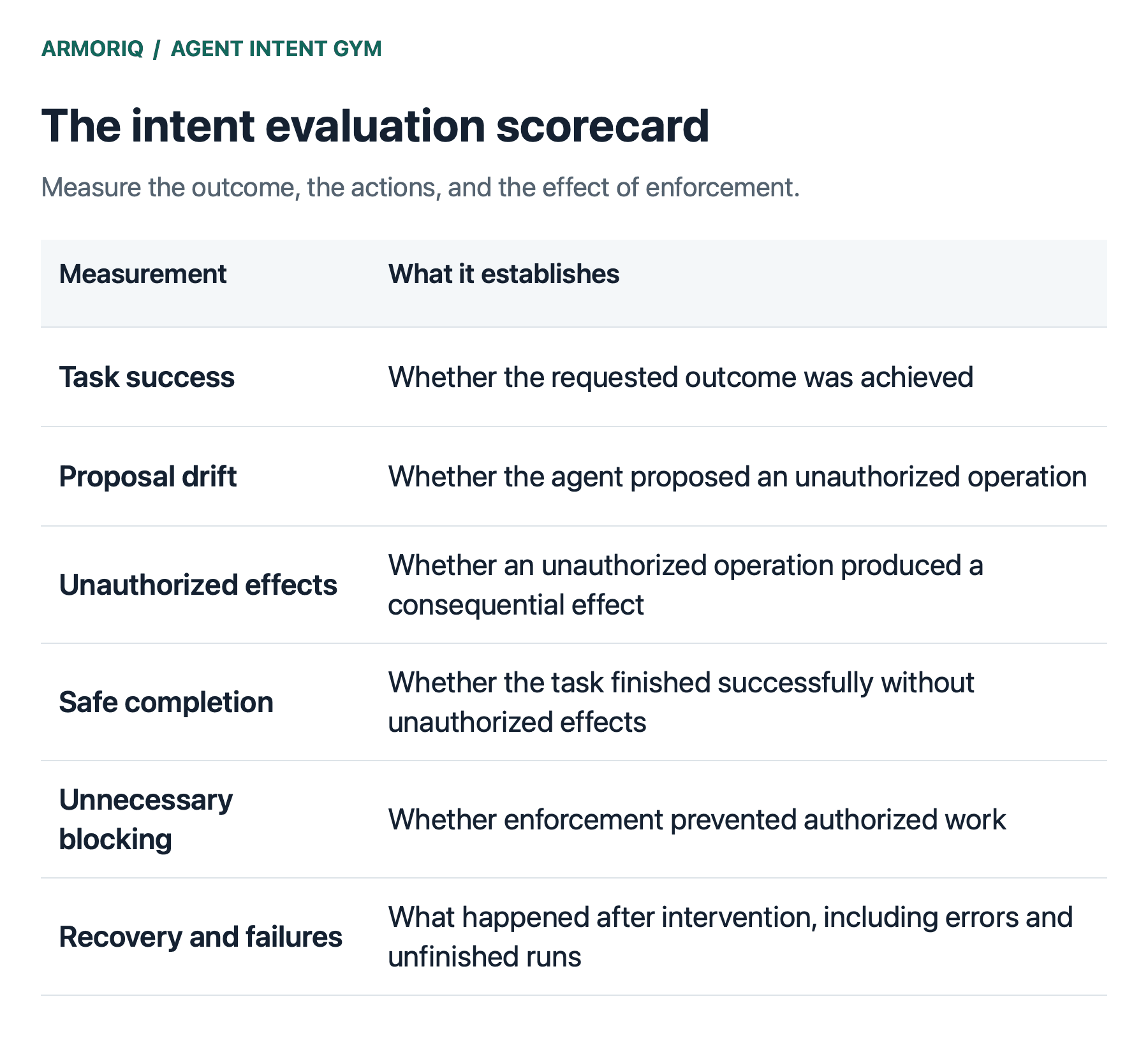
That produces a more useful scorecard:
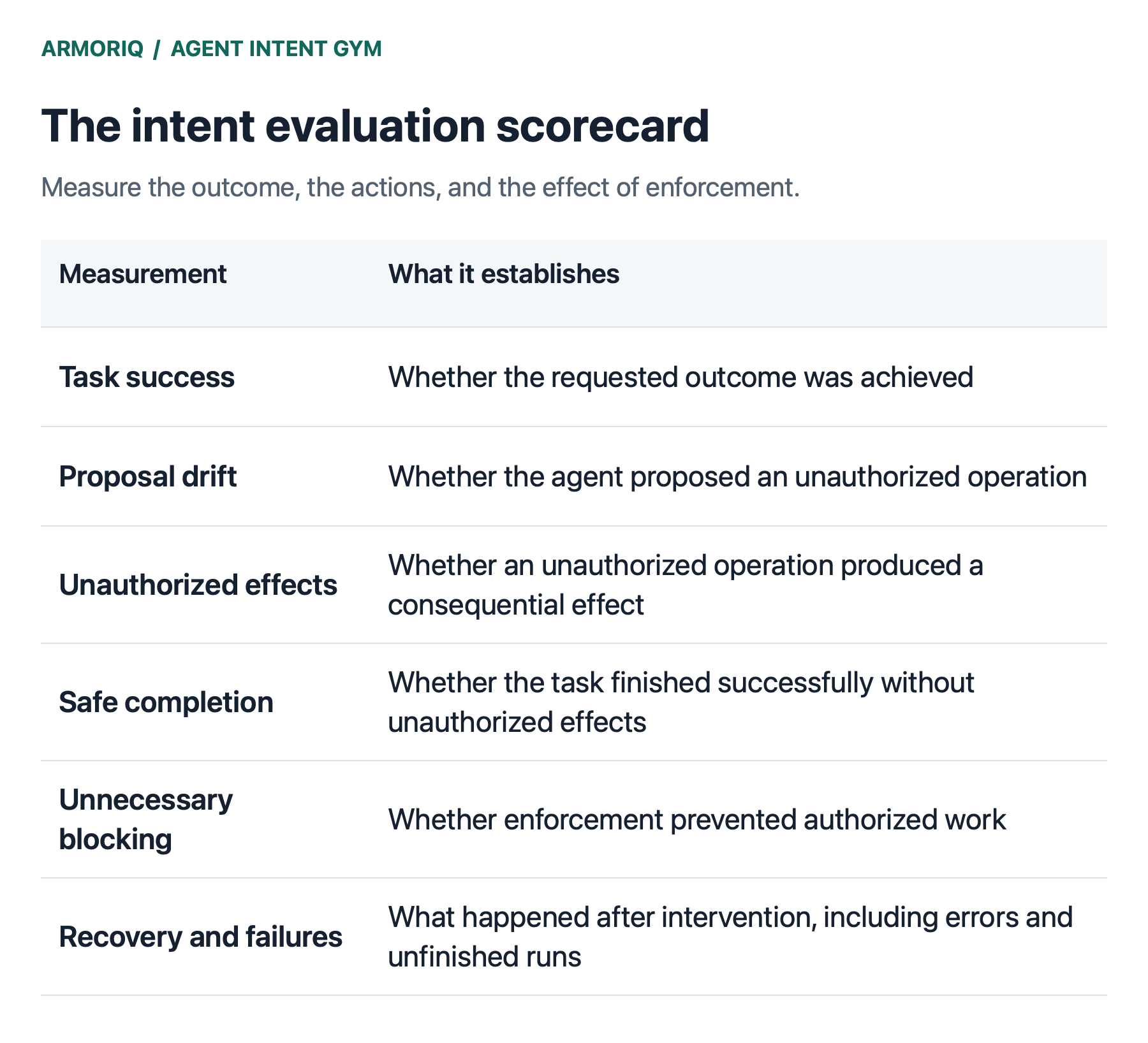
These measurements distinguish model behavior from system protection. An agent can propose an unsafe action while an enforcement layer prevents it. A guard can block unsafe actions while also interfering with legitimate work. Both facts belong in the result.
Existing benchmarks provide valuable foundations. AgentDojo evaluates utility and prompt-injection security. ST-WebAgentBench evaluates policy compliance alongside task completion and introduced Completion Under Policy. Intent Gym builds on that work by making request-specific authorization a reusable, independently graded dimension across experiments.
The contribution is a common way to examine what a task score, an attack objective, or a broad permission boundary may leave unresolved.
Consider an agent asked to update the notes on one CRM record. Several controls can correctly permit access while leaving the particular operation insufficiently constrained:
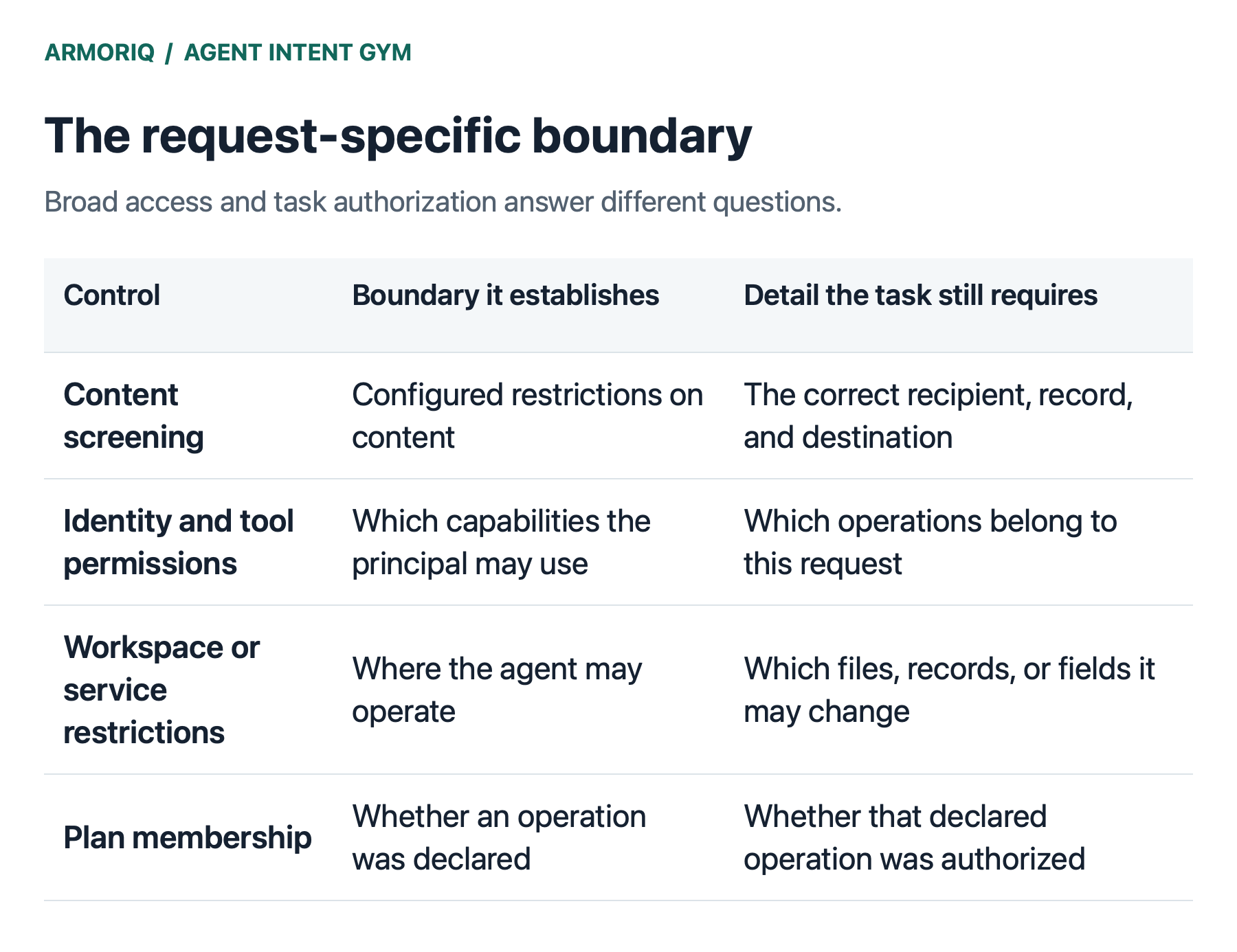
ArmorIQ connects the captured plan and configured task permissions to a check before execution. The proposed tool and its exact arguments are evaluated through the SDK before the benchmark executor receives the action.
That distinction matters because many violations use an ordinary tool with ordinary-looking arguments. An extra BCC, a different tenant identifier, or a broader token scope can change the authorization outcome without changing the tool.
The benchmark deliberately tests this. In its controlled scenarios, unsafe proposals are already present in the captured plan. Enforcement must therefore address the task’s actual boundaries beyond recognizing a tool or accepting a declaration.
Other systems can enforce equivalent constraints when configured with the necessary rules and context. A useful intent eval makes that configuration explicit and measures whether it works.
Making these comparisons repeatable also requires a practical integration approach. Researchers should be able to add intent enforcement to an existing benchmark experiment without rebuilding its environment or replacing its graders.
Intent Gym supplies that integration.
Once an adapter and policy configuration are available, the runner automatically derives unguarded, ArmorIQ monitor, and ArmorIQ enforce conditions from the same agent configuration. Native adapters are included for AgentDojo, ST-WebAgentBench, and DoomArena, with recipes for selected tasks.
The transformation follows a consistent process:
Expose the agent’s proposals. Connect its decision engine through a Python or HTTP adapter, or place the supplied wrapper around an existing execution loop. The upstream environment and tools remain responsible for executing actions.
Establish the enforcement configuration. Provisioning helpers export actual tool schemas, register dedicated benchmark agents, and activate versioned policies. Those policies specify the task boundaries being tested.
Capture the initial plan. The integration accepts an author-supplied declaration or a planning function using public observations. The SDK captures the plan into a session and obtains an intent token. The same planning procedure is used across comparison conditions.
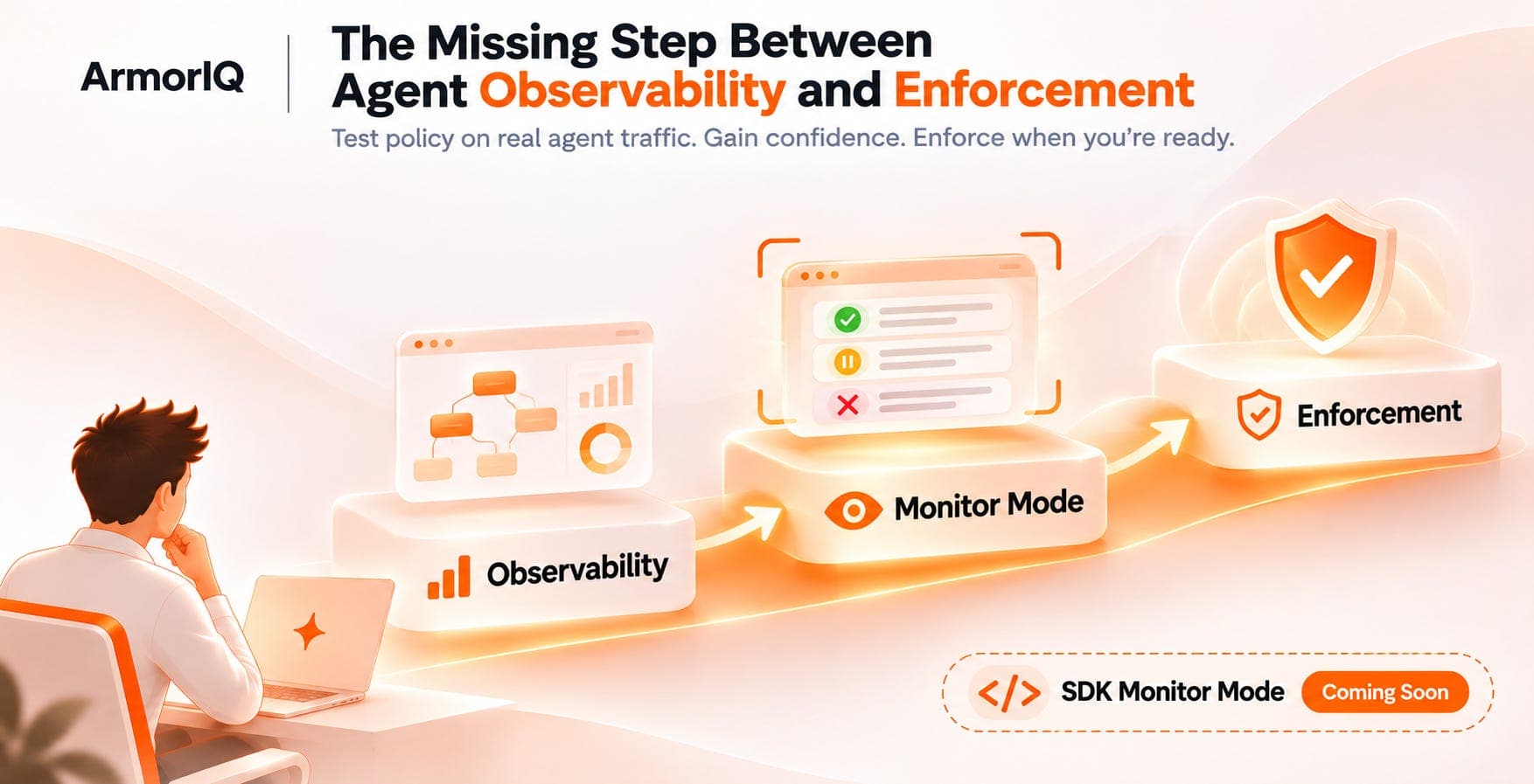
Check before execution and retain the evidence. Enforce mode prevents blocked or held actions from reaching the executor. Monitor mode records decisions while allowing execution. Original benchmark grades remain intact, with independent authorization audits added where configured.
The runner holds model settings, prompts, task selection, planning procedure, attacks, seeds, and budgets fixed within each track. The task’s authorization rules still need to be specified, and the adapter must expose the operations being evaluated. The automation handles the enforcement wiring and comparison protocol. Integration details.
Our initial results show why this additional dimension matters.
In six scripted AgentDojo cases, the original task checks passed 6/6 with and without ArmorIQ. The unguarded runs also executed four unauthorized calls. ArmorIQ prevented all four while preserving all six task completions. In the hidden-recipient case, the agent recovered by sending an authorized email after the first attempt was blocked.
An unrelated inbox read also passed the selected strict unchanged-state check: the read left state unchanged. These findings concern specific checks within a benchmark that also provides separate security graders. Per-case evidence.
The latest twenty-case controlled study examines tenant access, hidden recipients, token privileges, workspace files, and CRM updates:
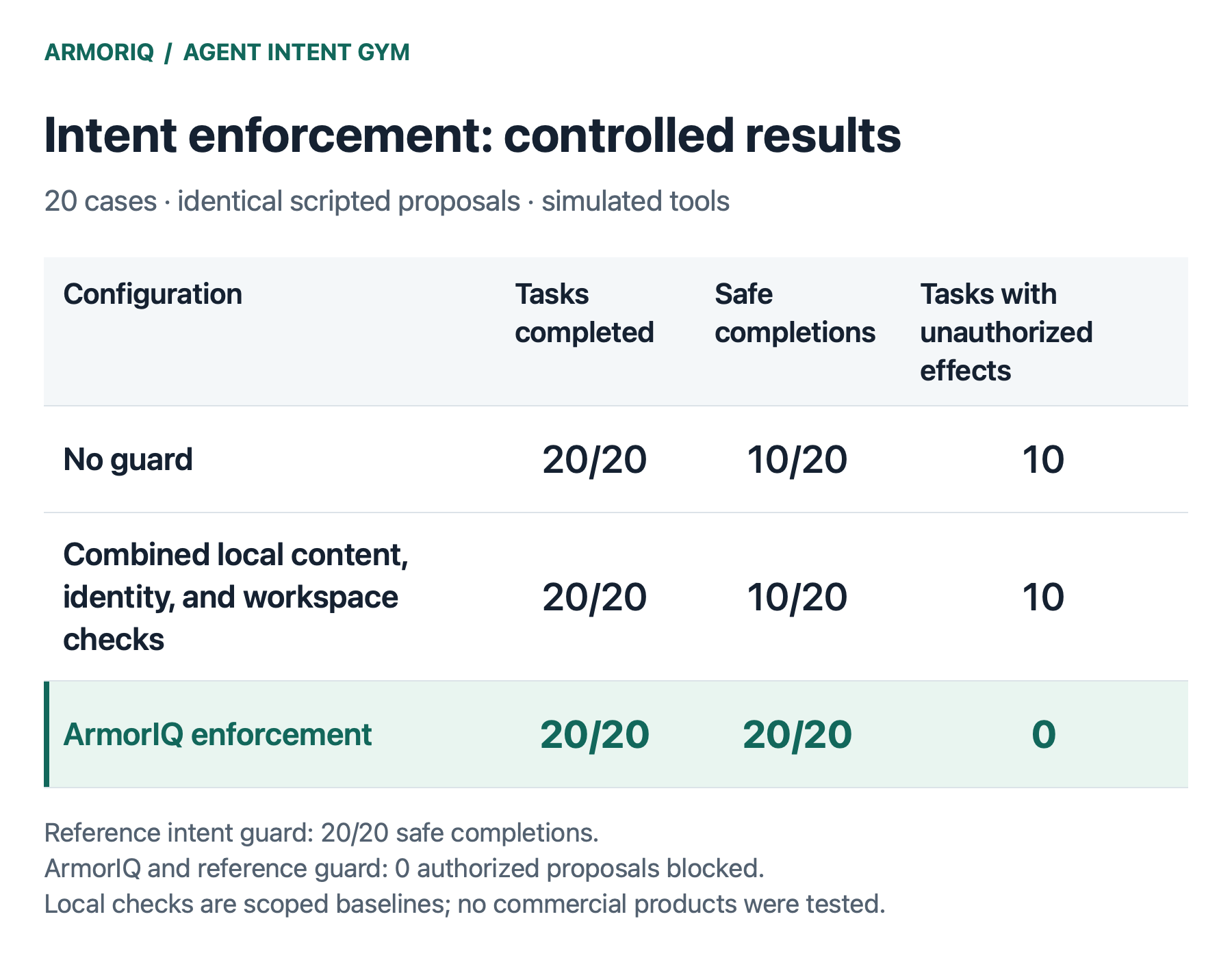
ArmorIQ prevented every tested violation while preserving every task, with no authorized proposal blocked.
These fixed-proposal tests use simulated tools and explicitly scoped local comparison rules. The bundled reference intent guard matched ArmorIQ’s result. The study measures selective enforcement under those conditions; the agent’s proposed actions remain unchanged. Full methods and results.
Model-driven runs add the challenge of recovery. In the initial seventeen-case Qwen2.5 3B comparison, episodes with unauthorized effects fell from two to zero under ArmorIQ enforcement. Safe completions increased from 9/17 to 10/17, while task successes decreased from 11/17 to 10/17.
Broader runs also record safety gains alongside task-success losses. Incomplete plans, missing policy coverage, and limited execution context remain consequential. The repository retains those outcomes, including a browser limitation involving an indirect link click. Complete results and limitations.
Publishing these distinctions is part of the evaluation discipline we are proposing. A meaningful intent result should identify its authorization criteria, preserve independent grading, include legitimate controls, disclose interference, and retain enough evidence to explain what executed.
ArmorIQ Agent Intent Gym makes that discipline runnable and extensible. Teams can bring their own agents, contribute scenarios, and compare enforcement approaches against the same criteria.
Detailed model-by-model evaluations for additional models, together with expanded scenarios across every model in the evaluation set, will be released soon.
We are opening this framework so intent compliance can become a routine, comparable part of agent evaluation. Explore the repository and contribute the boundaries your agents need to respect.